

- Katılım
- 4 Şub 2022
- Mesajlar
- 13,807
- Beğeni
- 12,735
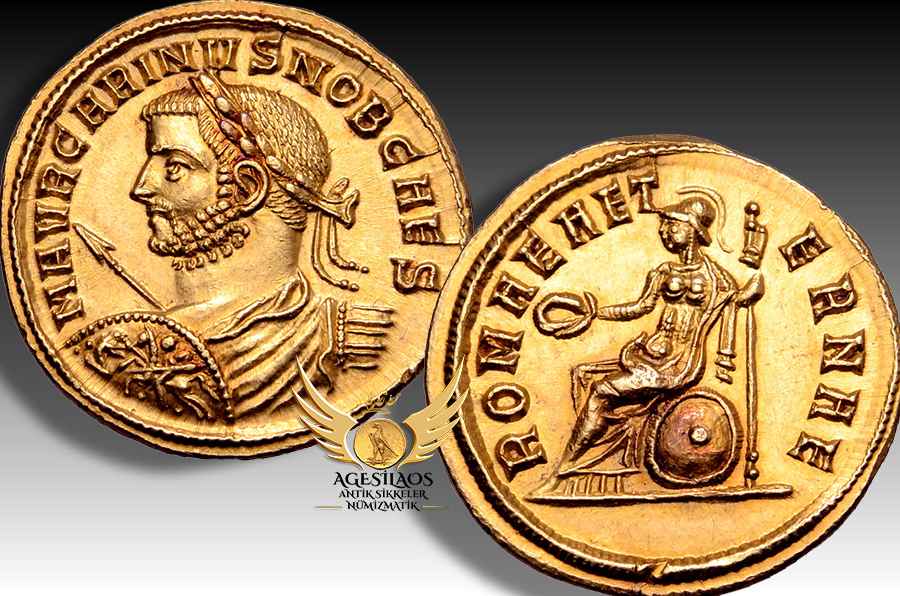
Raised to the rank of Caesar in the West in AD 282 under his father Carus, who had been proclaimed emperor after the assassination of the emperor Probus, Carinus immediately set out on campaign against the Germanic Quadi tribes whom he met with some success. Returning to Rome in early 283, he celebrated a triumph and was proclaimed Augustus, and thus began his joint rule with his father. Meanwhile his brother Numerian, also Caesar, was on campaign with their father against the Sassanid Persians in the East. It was here that Carus died in July or August 283, but not before having made significant gains against the Sassanids under Bahram II: he had taken the capital Ctesiphon, crossed the River Tigris and was marching his troops further into Mesopotamia.
Carus' death is most likely attributable to natural causes [an unknown illness, though some sources claim it was a lightning strike], and Numerian succeeded him as Augustus unchallenged. The army however wished to return to the West, and Numerian was unable to do more than acquiesce. As the column proceeded slowly back toward Roman territory Numerian himself was taken ill and died under suspicious circumstances the general Diocletian was proclaimed emperor by the troops and accepted the purple on a hill outside Nicomedia. Upon hearing the news, Carinus marched his army eastwards and the two met in Moesia at the Battle of the Margus River. Again, accounts differ as to the progress of the battle: some say that Carinus had the upper hand until he was assassinated by a tribune whose wife he had seduced, while others suggest that the battle was a complete victory for Diocletian and that Carinus' army deserted him. Following the victory, both the eastern and western armies recognised Diocletian as sole emperor, and he marched unopposed on Rome.
ROMAE AETERNAE - Romae Aeternae : Eternal Rome.
Carus' death is most likely attributable to natural causes [an unknown illness, though some sources claim it was a lightning strike], and Numerian succeeded him as Augustus unchallenged. The army however wished to return to the West, and Numerian was unable to do more than acquiesce. As the column proceeded slowly back toward Roman territory Numerian himself was taken ill and died under suspicious circumstances the general Diocletian was proclaimed emperor by the troops and accepted the purple on a hill outside Nicomedia. Upon hearing the news, Carinus marched his army eastwards and the two met in Moesia at the Battle of the Margus River. Again, accounts differ as to the progress of the battle: some say that Carinus had the upper hand until he was assassinated by a tribune whose wife he had seduced, while others suggest that the battle was a complete victory for Diocletian and that Carinus' army deserted him. Following the victory, both the eastern and western armies recognised Diocletian as sole emperor, and he marched unopposed on Rome.
ROMAE AETERNAE - Romae Aeternae : Eternal Rome.