

- Katılım
- 4 Şub 2022
- Mesajlar
- 13,804
- Beğeni
- 12,735
Yond Cassius has a lean and hungry look. He thinks too much, such men are dangerous. With these words Shakespeare's Julius Caesar describes Gaius Cassius Longinus, the man who would shortly become a ringleader in his assassination on the Ides of March of 44 BC. The so-called liberatores saw themselves as restoring freedom to the Roman people subjugated under the dictatorship-for-life of Julius Caesar, who had dismissed the checks and balances of the Roman Republican political system to achieve unprecedented power and complete control of the Roman state.
In the tumultuous aftermath of the assassination, Cassius, along with Brutus, formed an allegiance against the second triumvirate of Marc Antony, Octavian and Lepidus. A man with a lengthy and illustrious military record, Cassius had initial success in subduing the wealthy island of Rhodes in order to raise funds to prepare for the approaching confrontation. In 42 BC he rejoined Brutus at Sardis. The two thereupon resolved to confront their enemies and with their armies they crossed the Hellespont, marched through Thrace and encamped near Philippi in Macedon. There they would meet the combined armies of Antony and Octavian to determine the fate of the known world. Whereas Brutus' armies routed those of Octavian, Cassius was defeated by Marc Antony, and, unaware of his colleague's success, he thought the battle lost and committed suicide.
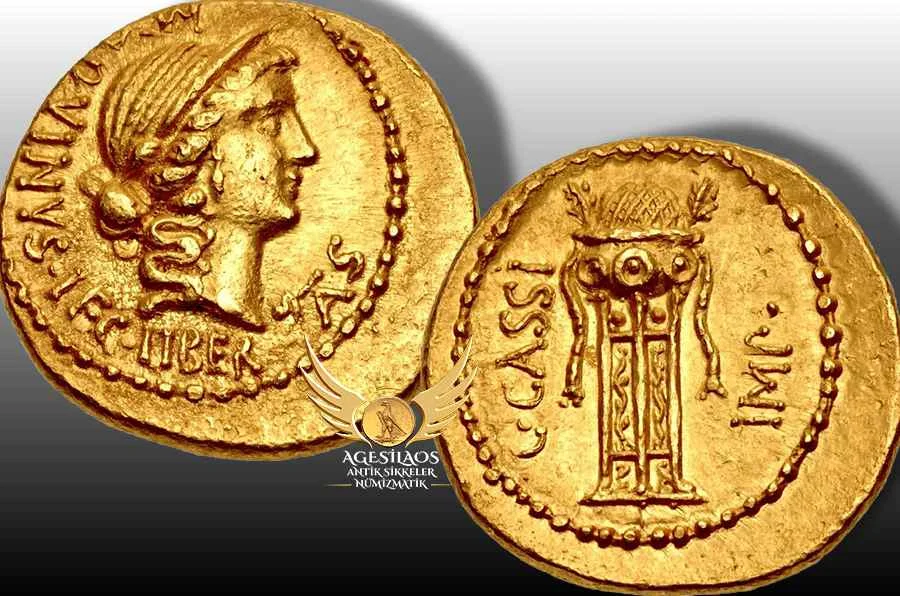
This remarkably rare issue which bears the bust of Libertas proclaims Gaius Cassius Longinus' intent to restore the proper system of rule embodied by the Roman Republic after the dictatorship of Caesar. The reverse is an allusion to Apollo and his role in prophecy, and potentially also references Cassius' membership in the college of the quindecimviri sacris faciundis. The college had custody of the sacred Sibylline Books, whose role in the Roman state at times of national crisis was the stuff of legend. The type was likely struck in Smyrna in the spring, prior to the Battle of Philippi, to celebrate the meeting of the two leaders and should be viewed as Cassius' counterpart to the EID MAR aureus of Brutus in its bold declaration of freedom. It is the first of Cassius' coinage to designate him imperator, [the traditional acclamation for victorious commanders that was needed to make the general eligible for a triumph].
In the tumultuous aftermath of the assassination, Cassius, along with Brutus, formed an allegiance against the second triumvirate of Marc Antony, Octavian and Lepidus. A man with a lengthy and illustrious military record, Cassius had initial success in subduing the wealthy island of Rhodes in order to raise funds to prepare for the approaching confrontation. In 42 BC he rejoined Brutus at Sardis. The two thereupon resolved to confront their enemies and with their armies they crossed the Hellespont, marched through Thrace and encamped near Philippi in Macedon. There they would meet the combined armies of Antony and Octavian to determine the fate of the known world. Whereas Brutus' armies routed those of Octavian, Cassius was defeated by Marc Antony, and, unaware of his colleague's success, he thought the battle lost and committed suicide.
This remarkably rare issue which bears the bust of Libertas proclaims Gaius Cassius Longinus' intent to restore the proper system of rule embodied by the Roman Republic after the dictatorship of Caesar. The reverse is an allusion to Apollo and his role in prophecy, and potentially also references Cassius' membership in the college of the quindecimviri sacris faciundis. The college had custody of the sacred Sibylline Books, whose role in the Roman state at times of national crisis was the stuff of legend. The type was likely struck in Smyrna in the spring, prior to the Battle of Philippi, to celebrate the meeting of the two leaders and should be viewed as Cassius' counterpart to the EID MAR aureus of Brutus in its bold declaration of freedom. It is the first of Cassius' coinage to designate him imperator, [the traditional acclamation for victorious commanders that was needed to make the general eligible for a triumph].