

- Katılım
- 4 Şub 2022
- Mesajlar
- 13,807
- Beğeni
- 12,735
Greek Baktrian Kingdom Demetrios I Aniketos - BAΣIΛEΩΣ ΔHMHTPIOY
Demetrios I Aniketos succeeded his father Euthydemos in circa 200 BC, inheriting a conflict with the Seleukid king Antiochos III. Reportedly impressed with the young prince Demetrios who conducted the treaty negotiations on behalf of his father Euthydemos, Antiochos III, judging from his appearance, conversation and the dignity of his manners that he was worthy of royal power, first promised to give him one of his own daughters, and secondly conceded the royal title to his father [Polybius 11.34]. Thus Demetrios I began his reign in the same vein as he maintained it, victorious, giving rise to his posthumous epithet aniketos, meaning the unconquered, since he was never defeated in battle.
It was Demetrios I who started the Greco-Baktrian invasion of northwestern India in 186 BC, conquering extensive areas of what is now southern Afghanistan, Iran, Pakistan and India. The well-known portrait of the king wearing an elephant skin headdress has been used in modern scholarship as emblematic of the Greek presence in Central Asia and India, and evolved from the numismatic portraits of Alexander the Great wearing an elephant skin headdress commemorating his own conquest of India in the late fourth century BC.
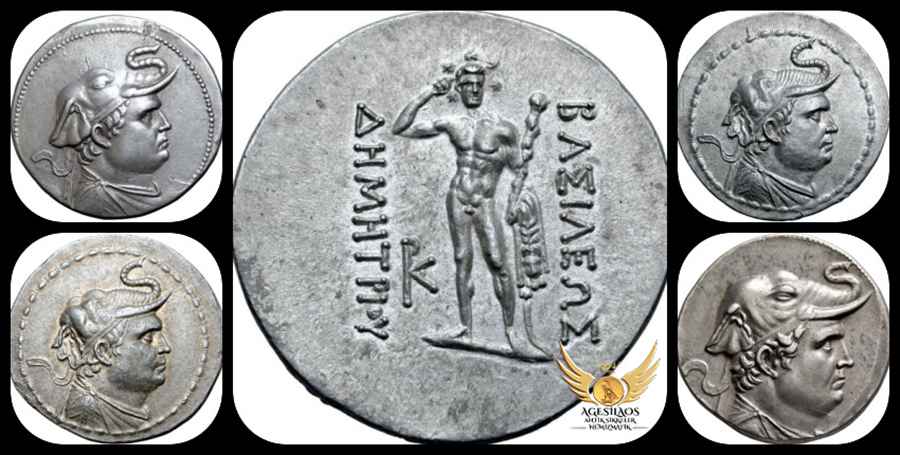
His coins show him wearing an elaborate headdress in the form of an elephant's head, including trunk and tusks. This is not just a reference to his Indian conquests, but also an homage to Alexander the Great, the first Westerner to enter India. The figure of Herakles crowning himself on the reverse alludes to tales of the demigod hero's travels to India.
Demetrios I Aniketos succeeded his father Euthydemos in circa 200 BC, inheriting a conflict with the Seleukid king Antiochos III. Reportedly impressed with the young prince Demetrios who conducted the treaty negotiations on behalf of his father Euthydemos, Antiochos III, judging from his appearance, conversation and the dignity of his manners that he was worthy of royal power, first promised to give him one of his own daughters, and secondly conceded the royal title to his father [Polybius 11.34]. Thus Demetrios I began his reign in the same vein as he maintained it, victorious, giving rise to his posthumous epithet aniketos, meaning the unconquered, since he was never defeated in battle.
It was Demetrios I who started the Greco-Baktrian invasion of northwestern India in 186 BC, conquering extensive areas of what is now southern Afghanistan, Iran, Pakistan and India. The well-known portrait of the king wearing an elephant skin headdress has been used in modern scholarship as emblematic of the Greek presence in Central Asia and India, and evolved from the numismatic portraits of Alexander the Great wearing an elephant skin headdress commemorating his own conquest of India in the late fourth century BC.
His coins show him wearing an elaborate headdress in the form of an elephant's head, including trunk and tusks. This is not just a reference to his Indian conquests, but also an homage to Alexander the Great, the first Westerner to enter India. The figure of Herakles crowning himself on the reverse alludes to tales of the demigod hero's travels to India.